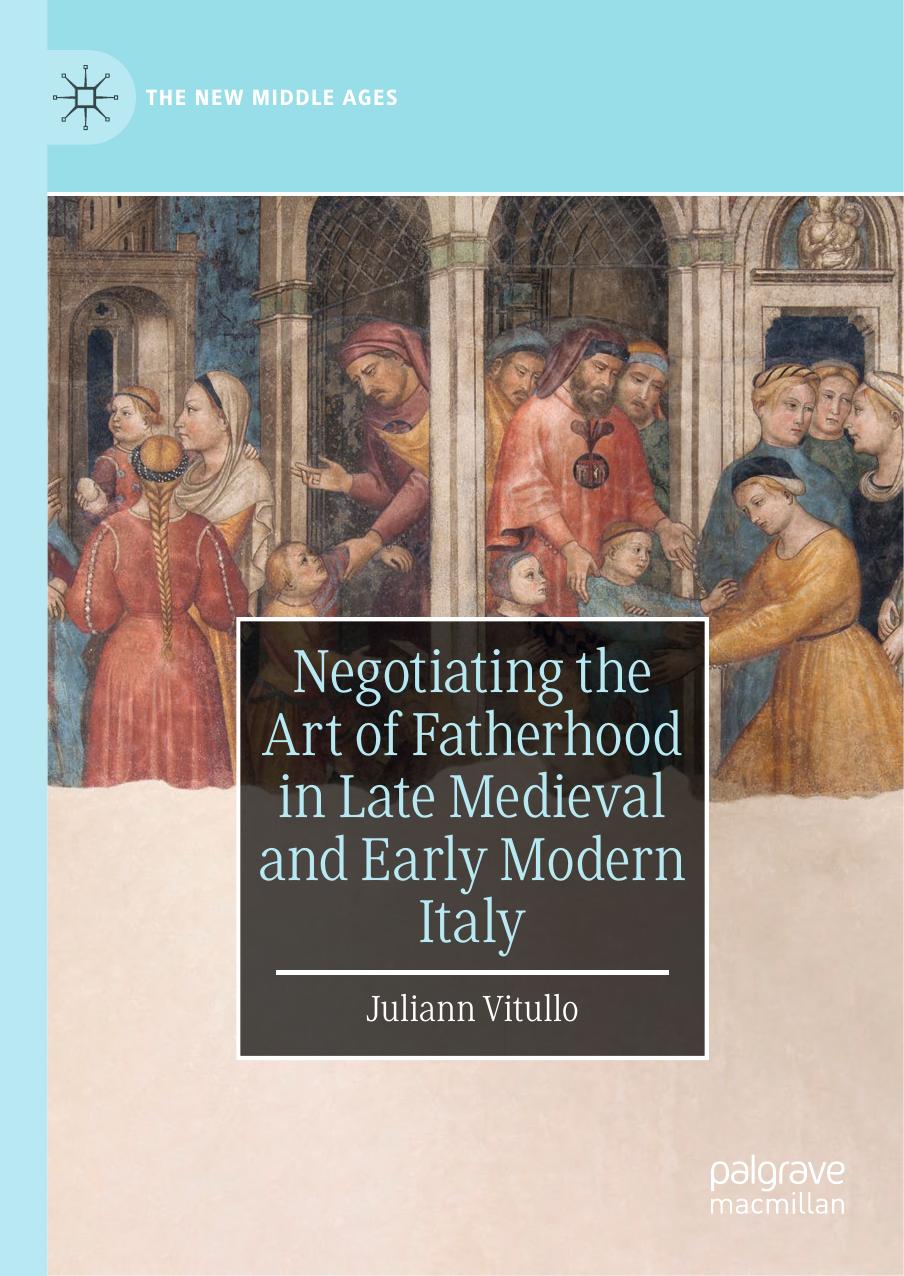
Negotiating the Art of Fatherhood in Late Medieval and Early Modern Italy by Juliann Vitullo
Author:Juliann Vitullo
Language: eng
Format: epub, pdf
ISBN: 9783030290450
Publisher: Springer International Publishing
For Bruni, a comparison of paternal behavior between two allegorical extremes illustrates the difference between the ancient and contemporary worlds. The “cruel and hard heart” of Tancred, the paternal representative of the constructed “Italian” culture, then, also suggests its myopic violence, which prevented the realization of the humanist ideal. Further, Bruni recognizes the physical and social importance of emotion in both the tale itself and its frame story.
Bruni’s pairing of the two novelle imitates the opposing categories of paternal behavior found in Valerius Maximus’s Memorable Doings and Sayings, where the Latin author provides the exemplum of “indulgent,” “gentle” fathers of “comedy,” as the story of Seleucus, in contrast with exemplum of “tragically harsh” paternal figures (Maximus 524–537). The alteration of comedic and tragic modes in Bruni’s text imitates a similar narrative rhythm of Boccaccio’s Decameron and focuses on the entire hybrid nature of the debate with its multilingual (Greek, Latin, and vernacular) and multicultural perspective for a mixed audience of men and women. While the text offers a dialogue between antiquity and contemporary cultures, it clearly associates the acceptance of a psychosomatic concept of love, based on the Aristotelian notion that the love is instigated by a desire for reproduction, as more “humane” and more pragmatic in terms of governance, both in households and for states. The proem of Boccaccio’s stories had described storytelling as an important form of relief and recreation for women who, due to social conventions and familial restraints “keep the flames of love hidden with their delicate breasts” (Proemio 10).8 Yet Bruni’s novelle emphasize the importance of recognizing passion for both men and women, particularly men in power.
In Bruni’s tale of Antiochus and Stratonice, fathers’ and rulers’ greatest concern should focus less on the use of violence to maintain their own power and more on their family’s future fertility and the stability of their territory. Once Seleucus brings his new young wife to court, her beauty and conversation conceive a “flame of burning love” in his son’s heart for his stepmother. Bruni adds details to the classical sources about how Antiochus and Stratonice spent time together because they were both teenagers and enjoyed the same activities like playing games and riding horses. These details suggest a natural attraction between two active young adults engaged in the same activities that Stratonice might not have shared with her much older husband: “finding herself often enjoying the company of the young Antiochus and at times playing games with him, other times horseback riding, not realizing or thinking about it, she generated in the mind of the youth a flame of burning love, which, growing day by day, gave birth to a wondrous blaze” (11).9 Bruni’s description of erotic passion, in particular, the image that Antiochus forms in his mind and obsesses about in his thoughts, follows the Aristotelian inspired tradition of Tuscan love poetry, including both Dante and Petrarch (Boyde 11–88). In this case, Bruni’s choice of the verb “partorire” to express how the youth’s passion begins or “gives
Download
Negotiating the Art of Fatherhood in Late Medieval and Early Modern Italy by Juliann Vitullo.pdf
This site does not store any files on its server. We only index and link to content provided by other sites. Please contact the content providers to delete copyright contents if any and email us, we'll remove relevant links or contents immediately.
4 3 2 1: A Novel by Paul Auster(12522)
The handmaid's tale by Margaret Atwood(7837)
Giovanni's Room by James Baldwin(7441)
Asking the Right Questions: A Guide to Critical Thinking by M. Neil Browne & Stuart M. Keeley(5839)
Big Magic: Creative Living Beyond Fear by Elizabeth Gilbert(5838)
Ego Is the Enemy by Ryan Holiday(5533)
The Body: A Guide for Occupants by Bill Bryson(5182)
On Writing A Memoir of the Craft by Stephen King(5005)
Ken Follett - World without end by Ken Follett(4790)
Adulting by Kelly Williams Brown(4624)
Bluets by Maggie Nelson(4607)
Eat That Frog! by Brian Tracy(4603)
Guilty Pleasures by Laurell K Hamilton(4512)
The Poetry of Pablo Neruda by Pablo Neruda(4173)
Alive: The Story of the Andes Survivors by Piers Paul Read(4082)
Fingerprints of the Gods by Graham Hancock(4050)
The Book of Joy by Dalai Lama(4048)
White Noise - A Novel by Don DeLillo(4047)
The Bookshop by Penelope Fitzgerald(3903)
